
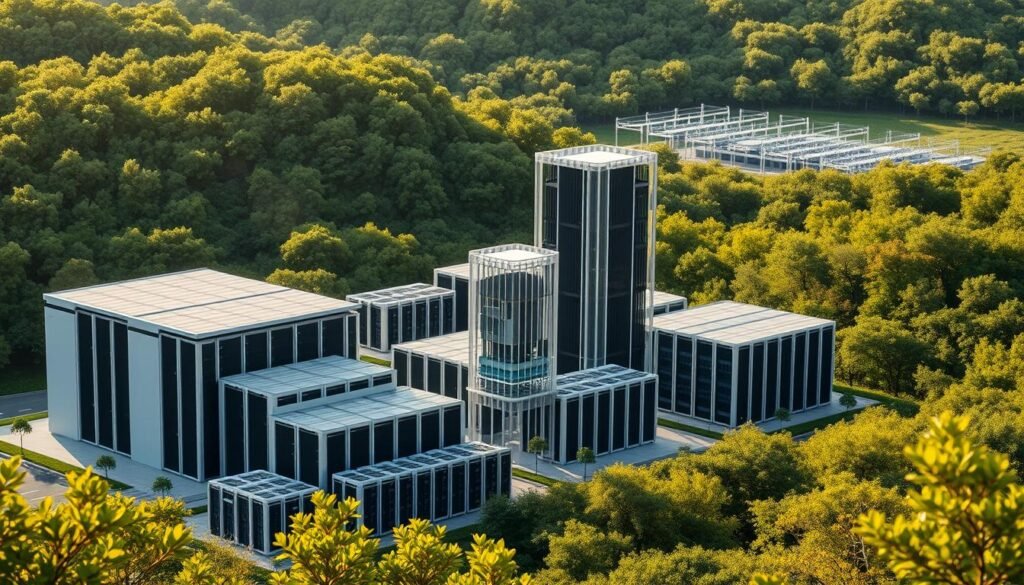

Did you know that the world’s data centers now consume more electricity than entire countries like Iran or Australia? This staggering fact highlights the massive scale of our digital infrastructure and the urgent need for change.
You’re witnessing a complete transformation in how information gets processed. The demand for computing power keeps growing at an incredible rate. This growth pushes the industry toward smarter, more efficient solutions.
Three key trends are shaping this evolution. Green energy integration reduces environmental impact. Autonomous systems optimize operations without constant human oversight. Distributed architectures bring processing closer to where it’s needed.
Your organization faces critical decisions about digital infrastructure. Traditional approaches can’t handle today’s demands. The industry must balance performance with responsibility.
Innovative technologies offer promising solutions. They deliver higher performance while using less energy and water. This comprehensive analysis explores how these changes will define the infrastructure landscape for decades.
Understanding these trends is essential for your digital strategy. They influence everything from application deployment to environmental commitments. The future demands smarter, more responsive infrastructure.
Key Takeaways
- Data centers now consume more power than entire countries, driving urgent innovation
- Three core pillars are reshaping the industry: green energy, automation, and distributed computing
- Exponential growth in digital services creates unprecedented infrastructure demands
- Traditional centralized facilities must evolve alongside emerging edge architectures
- New technologies enable higher performance with reduced environmental impact
- Strategic infrastructure decisions now impact long-term sustainability and efficiency
- The industry stands at a critical crossroads between computational needs and environmental responsibility
Understanding the Evolving Landscape of Data Centers
What began as basic computer rooms in the 1990s has exploded into industrial-scale operations consuming power rivaling small municipalities. Your digital infrastructure has undergone a complete metamorphosis.
A Historical Perspective on Data Center Growth
The evolution started with simple server installations. Cloud computing adoption created the first major expansion wave. Streaming services and social platforms drove the next capacity surge.
Today, artificial intelligence applications demand unprecedented computational resources. Facilities now span hundreds of thousands of square feet. This growth trajectory shows no signs of slowing.
Current Industry Challenges and Opportunities
Your awareness of industry challenges must include massive capital requirements. Aggregate spending could reach $250 billion in 2025 across all providers. The U.S. market supply jumped 26% year-over-year to 5.2 GW in 2023.
Cloud providers and AI workloads create intense demand pressure. This expansion tests existing infrastructure limits. Global electricity consumption patterns show increasing pressure on grid systems.
Projections indicate consumption rising from 25,585 TWh in 2022 to 29,160 TWh by 2030. Technological innovations present promising opportunities. They address capacity constraints while improving energy efficiency.
The fundamental challenge involves meeting computational demands within environmental regulations. Your strategic planning must balance growth with responsibility.
The Rise of Green Data Centers and Renewable Energy Solutions
The digital world’s growing appetite for electricity has sparked an industry-wide pivot toward environmentally conscious power solutions for computing facilities. You’re seeing technology giants make unprecedented commitments to clean energy sources.
Exploring Clean Energy Investments
Major companies are investing billions in renewable energy projects. Google alone has signed over 170 agreements for clean power worldwide. These contracts cover more than 22 gigawatts of capacity.
The scale of investment demonstrates serious commitment to green transformation. Companies have poured over $3.7 billion into clean energy partnerships. This funding powers operations with responsible sources.
| Company | Clean Energy Commitments | Investment Scale | Annual Renewable Match |
|---|---|---|---|
| Industry Leader | 170+ agreements | $3.7+ billion | 100% since 2017 |
| Major Cloud Provider | 15+ gigawatts | $2.1 billion | 95% achieved |
| Technology Giant | 12 gigawatts | $1.8 billion | 98% target |
Innovative Approaches to Water Cooling and Sustainability
Water cooling represents an energy-efficient method for heat removal. It often provides better options than traditional air conditioning systems. These approaches consume significantly less power.
Leading operators take climate-conscious approaches to cooling decisions. They balance carbon-free energy availability with responsibly-sourced water. This includes alternatives to freshwater resources.
The solutions extend beyond facility operations. Companies support watershed projects that benefit local communities. These initiatives replenish consumption and protect ecosystems.
sustainable data centers edge computing data center AI in data center manageme
The next wave of infrastructure evolution merges distributed processing with intelligent control systems. Your facilities now operate with unprecedented coordination between localized and centralized resources.
This integration creates a responsive network that adapts to changing demands. Time-sensitive tasks process locally while complex operations run in larger facilities.
Integrating Edge Computing and Autonomous Systems
Distributed architectures work alongside self-regulating operations. Your system automatically routes workloads to optimal locations based on priority and resource availability.
Local processing reduces transmission energy significantly. This approach benefits applications requiring immediate response times.
Optimizing Energy Use Through AI-Driven Management
Intelligent systems continuously monitor and adjust power consumption. They predict equipment needs before issues arise.
Your cooling systems respond to real-time temperature changes automatically. This prevents energy waste during low-usage periods.
Predictive analytics forecast demand patterns with remarkable accuracy. You can provision resources more efficiently, avoiding unnecessary capacity expansion.
These technologies transform passive facilities into active, self-improving environments. They achieve efficiency gains previously impossible through manual oversight.
Embracing Edge Computing for Real-Time Data Processing
The shift toward localized processing represents a fundamental change in how digital services operate. You now have the ability to handle information where it originates rather than sending it across networks.
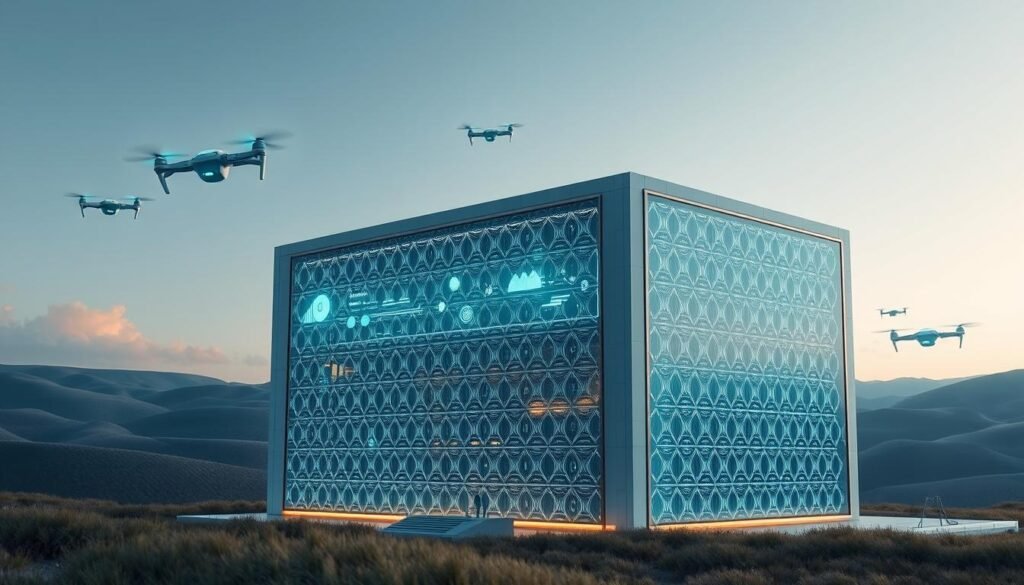
This approach eliminates the delays of distant cloud servers. Your applications gain immediate responsiveness that transforms user experiences.
Edge AI: Bringing Computation Closer to the Source
Intelligent systems now run directly on devices like smartphones and vehicles. Waymo’s autonomous vehicles demonstrate this capability perfectly.
They process sensor information instantly for navigation decisions. This immediate processing prevents safety hazards that cloud-dependent systems couldn’t avoid.
Small Language Models enable this localized intelligence. They operate efficiently without constant internet connectivity.
Impact on Speed, Efficiency, and Environmental Footprint
Your services benefit from dramatically reduced latency. Local processing cuts transmission energy significantly.
Edge infrastructure can enter dormant modes during idle periods. This reduces power consumption without sacrificing quick response capabilities.
Truck platooning shows the real-world efficiency gains. Coordinated convoys improve fuel efficiency by up to 10% through optimized spacing.
Natural cooling advantages in appropriate climates further enhance the environmental benefits. Your organization achieves better performance with reduced resource consumption.
The Role of Artificial Intelligence in Data Center Operations
Cooling requirements consume nearly half of all energy in computing facilities, creating a prime opportunity for AI intervention. Your operations can achieve remarkable efficiency gains through intelligent thermal management.
AI-Enhanced Cooling and Power Consumption Strategies
Machine learning algorithms continuously monitor temperature patterns and workload demands. They automatically adjust cooling power to maintain optimal conditions while minimizing waste.
These intelligent systems detect subtle correlations human administrators might miss. Your facility benefits from precise adjustments based on real-time analysis.
The energy savings potential is substantial. Operations can achieve 2% to 5% reductions in cooling consumption with every 1°C temperature increase that AI safely implements.
Artificial intelligence enables advanced cooling technologies like direct-to-chip and immersion methods. These approaches distribute heat directly to components or submerge servers in dielectric coolant.
Power optimization extends beyond cooling to include intelligent workload placement. Your management system ensures resources match current demand levels precisely.
Predictive maintenance prevents equipment failures that cause inefficient operations. Artificial intelligence identifies performance degradation before it impacts your facility’s energy consumption.
Analyzing Energy Consumption Trends and Future Projections
Current projections indicate that information processing facilities will soon rival major industrial sectors in electricity demand. Your understanding of this growth trajectory is essential for strategic planning.
Insights from Industry Reports and Global Data
U.S. facilities consumed 176 TWh in 2023, representing 4.4% of national electricity usage. This significant consumption figure continues to climb annually.
The International Energy Agency forecasts global energy demand from these facilities will more than double by 2030. The projected 945 TWh slightly exceeds Japan’s current total electricity consumption.
Regional impacts vary dramatically. Ireland now dedicates one-fifth of its electricity to these operations. This proportion is expected to grow, creating local challenges for grid stability.
The Impact of Increasing Workloads on Energy Demand
Complex applications drive unprecedented power requirements. AI model training, cloud services, and streaming media generate more heat than traditional workloads.
Individual queries reveal the scale of collective consumption. An average ChatGPT request uses approximately 0.34 watt-hours of electricity. Multiply this by billions of daily queries to understand the massive energy footprint.
Water usage trends highlight additional resource constraints. China’s annual consumption is expected to increase from 1.3 billion cubic meters in 2023 to over 3 billion by 2030.
Autonomous Technologies Transforming Data Center Management
The arrival of self-managing systems marks a pivotal moment for facility operations. Your infrastructure now benefits from intelligent technologies that monitor and adjust without constant human input.
This shift dramatically improves both efficiency and reliability across your entire operation.
Self-Regulating Systems and Predictive Maintenance
Thousands of sensors continuously collect performance data on temperature, power use, and equipment health. Intelligent systems analyze this information to make real-time optimization decisions.
Your operations gain predictive maintenance capabilities. These technologies forecast potential equipment failures before they cause outages. This allows you to schedule repairs during planned downtime.
Hardware selection is also evolving. Specialized chips like NPUs and ASICs offer far greater energy efficiency for specific workloads than general-purpose processors.
| Chip Type | Quantity for AI Model Training | Time Required | Power Consumption |
|---|---|---|---|
| Previous Generation | 8,000 chips | 90 days | 15 MW |
| Nvidia Grace Blackwell | 2,000 chips | 90 days | 4 MW |
This demonstrates the dramatic efficiency improvements possible with modern technologies. Your data center can achieve more work with significantly less power.
Autonomous management systems also dynamically allocate workloads across servers. They ensure optimal resource use based on current capacity and performance needs.
Your data center equipment enjoys a longer lifespan through continuous monitoring. This proactive approach prevents small issues from becoming major problems.
Integrating Renewable Energy and Sustainable Infrastructure Practices
Modern infrastructure planning must address both energy generation and resource conservation to create truly responsible operations. Your approach goes beyond simple energy credits to achieve comprehensive environmental strategies.
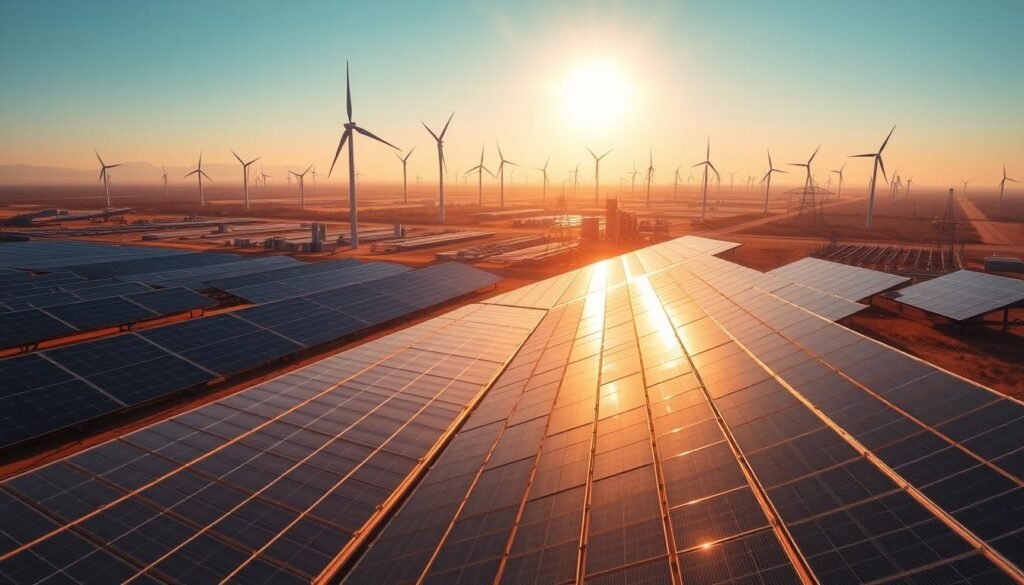
The Role of Solar Power, Water Stewardship, and Green Materials
On-site solar installations provide clean electricity directly to your facilities. This reduces transmission losses and demonstrates visible commitment to environmental responsibility.
Energy storage systems address the intermittent nature of renewable sources. They ensure consistent operations even when solar generation fluctuates.
Water stewardship extends beyond individual facilities. Companies support watershed projects that benefit local communities and ecosystems.
Construction practices now minimize material quantities and use alternatives like green concrete. These approaches reduce the environmental impact from the very beginning.
Utility partnerships help organizations purchase 24/7 clean energy. Programs specifically designed for computing facilities advance grid decarbonization while meeting unique power requirements.
While nuclear options are discussed, proven renewable technologies often offer better cost and deployment timelines. Your long-term savings justify the initial infrastructure investment.
Conclusion
A new era of intelligent infrastructure is emerging that balances computational power with ecological consciousness. Your organization’s future success depends on embracing this transformation.
The hybrid model represents the optimal approach moving forward. Complex training occurs in large facilities with abundant resources. Real-time applications then run efficiently at distributed locations.
This balanced strategy addresses growing industry challenges while improving performance. It reduces operational costs and increases system resilience for your applications.
You can take immediate action by evaluating distributed processing options. Explore renewable energy partnerships and implement intelligent management systems. These steps position your organization for success in the evolving digital landscape.
The convergence of green energy, autonomous operations, and distributed computing creates more specialized, efficient infrastructure. Your strategic decisions today will determine competitive advantage tomorrow.